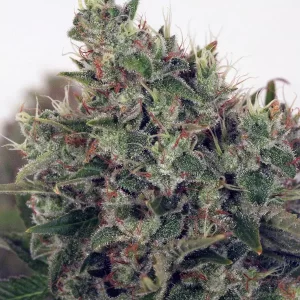
White Widow Feminized

(10 customer reviews)

Price range: 12,50 € through 101,00 €

White Widow: a name, a legend. White Widow is a cross between Indian and Brazilian.

SKU: WW-FEM Category:

Description

White Widow: a name, a legend. This plant has appeared on the market in 1995 and it has been the dominator of the scene ever since. White Widow is a cross between Indian and Brazilian, medium height, excellent taste with notes of fruit. The subtle aroma reminds you of the fresh pine cones when they are still on the trees. The high is strong both on the mind and on the body, but not at all lethargic. It performs well in sea of green and it doesn’t dislike it if you reduce the amount of light in the last days of flowering to further stimulate the resin production.

Available in bags of 2, 5, 10 and 25 seeds.

Kind of seeds: Female

Indoor/Outdoor

60% Sativa 40% Indica

Flowering Time: 8-10 weeks

Yield: 450 gr per sq. mt. indoor, up to 300 gr per plant outdoor

Flavor: fresh pine cones

Effect: strong both on the mind and on the body

THC: 18%

CBD: low

Additional information

Weight0,0100 kg
AUTOFLOWERING FEMINIZED

Bag of

, , ,

EFFECTS

, ,

FAMILY

, ,

FLAVORS

INDICA - SATIVA

10 reviews for White Widow Feminized

  1. Spencer

    I recently did my research after my go to seedbank had issues with my debit card and found MOC to appear at the top with quality being first followed by delivery and customer service which also appear top notch. I ordered 2 separate deliveries (within a day of each other, but 2 separate tracking numbers) from MOC and another from another site. The two orders were separate because I run a perpetual harvest and keeping a deadline is important. MOC delivered VERY quickly, and ALL 10 white widows popped. My second order of 5 northern lights, however, never came and appeared to be checked off the same time as my in person pickup as the white widows despite two different tracking numbers and only one pick up. Not sure if this was an MOC error or post office, but the germination rate, price, and quick shipping time saved my deadline because my second site I ordered from using an alternative payment other than credit or debit has yet to give me a tracking number and I’m on a very time sensitive schedule (as if I haven’t said that enough, haha). For the price, quick delivery, and quality I’ve thoroughly researched it’s still worth it.

  2. Mr growgood-newbie

    Very strong plant that can take a beating i.e my plant had to go outside whilst the others were in bloom. The plant then got infested with caterpillars of 2 types which ate out the tops of plant, Plant slowly recovered then only to have the stem split down the centre from its original topping from me no worries added honey to split centre stem & added budding tape & electrical tape healed again like new & buds are very tight hard & Very resinous.
    Only thing about this plant I have found is it’s strong odour so make sure you use a carbon filter & vent it out into you ceiling cavity.I also found this plant to grow slow but with all the drama’s I had I can accept that Overal taste potency Smell & High 9/10 probably why I have 13 seeds left LOL

  3. Nicegirl

    A great strain for any beginner to grow. Grows well indoors and shows signs of pre-flower at around 7-8 weeks. Grew 4 of these recently and produced all female plants with a total yeild of about 11 oz. Flowering time for good cerebral buzz was just over 9 weeks. GREAT buzz and long lasting! Very social experience and definitely a must grow again species.

  4. Darksinz

    Ordered thru single seed.got skunk but bonus seed was white widow.6 skunks two popped.hermies.grew the one widow.kept alive thru clones for two years.great cloner.medium height.yet I call it white widow cat piss. Had that cat spray smell.not strong in jar but potent in a bag. Top of my strain list.rubbing crystals between thumb during flowering smells of grapefruit.high is more on body side.makes u kinda upbeat as well .

  5. Rodeostyle

    Indoor grow, 600w MH and HPS. Excellent growth and bud development. Responds well to topping and LST. Averaging 320g cured product in 5 plant grow. Ministry has very good turn around time.

  6. Anna

    I’ve STILL got a 100% success rate with deliveries from MoC! I just received some White Widow seeds, 8 days after ordering, in Western Australia. I’ve never grown WW before, so I’m looking forward to seeing how they go. BigBud xxl are always my favourite go to strain though.

  7. TAKESHI

    I love this seed.
    A variety recommended for beginners.

  8. John

    Grew outdoors, got 12 foot tall and yielded 33.65 ounces. Waiting for test results, but it tastes like hash and is very potent. Great for me, cause i get chemo for my cancer. Thanks

  9. AussieGrower

    I’m excited to see this grow pan out, given it’s my first WW experience. I’m really impressed with MoC. Great delivery success and speed. The one thing that tempts me back to ordering off their competitors is the SALES and the BONUS SEEDS! Perhaps the Ministry should consider implementing those marketing ideas?

  10. Rooster

    Growing 1 White widow indoors along with Big Bud/North Lights/ Man Haze/ So far the Mandarin Haze is the furthest along, Followed by White Widow. The Widow buds are just has fat as my Big Buds but plant is a lot shorter and won’t yeild no more then a 450 grams which I am still very happy with. Overall White Widow is a fantastic strain. It’s a shame my last order of 2 White widow along with 5 Cbd Star and 5 Carnival were intercepted twice by Australian Customs. So this will be my last time Buying from Ministry as Australian Customs is just to damn strict.

Show reviews in all languages (15)

Add a review

Your email address will not be published. Required fields are marked *


Breeder´s Notes

White Widow: History, Genetics, Characteristics, and Cultural Impact

Overview

White Widow is one of the most recognizable cannabis strains in modern history. Since the early 1990s, it has played a central role in shaping how hybrid cannabis varieties are understood, described, and compared. Known for its resin-heavy appearance and balanced profile, the White Widow strain became a reference point long before today’s explosion of genetics and branding.

Unlike many contemporary cultivars that rise quickly and disappear just as fast, White Widow has remained relevant for decades. Its reputation is rooted not in novelty, but in consistency, recognizability, and a combination of traits that defined an era of cannabis breeding.

Origins and historical background

The origins of White Widow are closely linked to the European cannabis scene of the early 1990s, particularly the Netherlands. At the time, Amsterdam was becoming a hub for genetic experimentation, with breeders working to stabilize and refine hybrids that could deliver predictable results.

White Widow is widely described as a hybrid with influences from South American and South Asian landrace genetics. While exact parentage has been debated over the years, its emergence marked an important step toward more standardized cannabis strains. In an era when many varieties were unstable or poorly documented, White Widow stood out for its uniformity and reliability.

By the mid-1990s, it had already gained international recognition, winning awards and becoming a staple in coffee shops and seed catalogs. This rapid rise helped cement its status as a foundational strain rather than a passing trend.

Genetic profile and classification

From a classification standpoint, White Widow is commonly described as a balanced hybrid. This does not imply perfect symmetry between indica and sativa traits, but rather a combination of characteristics that influence both physical structure and subjective effects.

Genetically, it became influential not only as a finished strain, but also as breeding material. Numerous later hybrids trace part of their lineage back to White Widow, borrowing its resin production, vigor, or overall balance. In this sense, White Widow functions as a genetic reference point within modern cannabis breeding.

Physical characteristics and appearance

One of the defining features of the White Widow strain is its visual presentation. Mature flowers are known for their exceptionally heavy trichome coverage, giving the buds a frosted or crystalline appearance. This characteristic played a major role in the strain’s name and early reputation.

Typical visual traits often include:

  • Dense, compact buds

  • Bright green coloration with contrasting white resin

  • Prominent trichome development across calyxes and sugar leaves

  • Orange to reddish pistils depending on phenotype

Because of this appearance, White Widow is frequently cited when explaining what high-resin cannabis looks like, even in educational or botanical contexts.

Aroma and flavor profile

Descriptions of aroma and flavor associated with White Widow tend to be consistent across sources, though individual samples can vary. Commonly reported notes include earthy and woody tones, subtle spice, and mild herbal freshness. Some phenotypes may also express hints of pine or floral sharpness.

These sensory traits are largely attributed to its terpene composition, which contributes to both aroma perception and overall experience. As with all cannabis varieties, environmental factors and post-harvest handling can significantly influence how these characteristics present themselves.

Chemical composition

In analytical discussions, White Widow is often referenced for its balanced cannabinoid profile rather than extreme potency. Historically, it was considered strong for its time, but by modern standards it is generally viewed as moderate to moderately high in THC content, depending on the specific expression.

This balance made White Widow especially useful as a comparison strain. When newer varieties are described as “stronger than White Widow” or “more relaxing than White Widow,” it highlights how deeply embedded the strain is in cannabis discourse.

Reported effects and perception

When effects are discussed in a neutral, descriptive way, White Widow is commonly associated with a combination of mental alertness and physical relaxation. Many reports describe an initial sense of clarity or uplift, followed by a calmer, grounded physical sensation.

Importantly, these effects are subjective and influenced by many factors, including individual sensitivity, dosage, and context. For this reason, responsible sources avoid framing White Widow as universally stimulating or sedating, instead emphasizing its reputation for balance.

This versatility contributed significantly to its widespread adoption and long-term popularity.

Seeds and genetic preservation

Because of its historical importance, White Widow is frequently mentioned in discussions about cannabis seeds and genetic preservation. Terms such as semi di White Widow or references to feminized versions appear in catalogs and archives as part of broader documentation efforts.

From an educational standpoint, seed references relate to how genetic traits are maintained and reproduced over time. White Widow’s stability made it an attractive candidate for breeding programs focused on consistency and predictability.

Today, many variations exist under the same name, making provenance and documentation especially important when accuracy is required.

Variants and naming evolution

Over the decades, multiple interpretations and selections of White Widow have emerged. Some emphasize resin production, others lean toward particular aromatic expressions or growth structures. This has led to subtle differences between versions sold under the same label.

Plural forms such as white widows are sometimes used informally to refer to this family of related expressions rather than a single, fixed genetic specimen. While convenient in conversation, such terminology underscores the importance of understanding White Widow as a genetic lineage rather than a single immutable plant.

Cultural impact and legacy

Few cannabis strains have achieved the cultural reach of White Widow. Its name appears in books, magazines, documentaries, and online discussions spanning more than three decades. For many people, it served as an introduction to hybrid cannabis and helped shape early expectations around quality and effects.

Even as newer genetics dominate headlines, White Widow remains a benchmark. Its continued presence in educational content and market analysis reflects its role as a foundational strain rather than a novelty item.

Why White Widow still matters

White Widow’s lasting relevance comes from a rare combination of factors: recognizable appearance, balanced characteristics, genetic influence, and historical timing. It arrived at a moment when cannabis breeding was becoming more intentional and documented, and it helped define what a “modern classic” could be.

Rather than being remembered as the strongest or most exotic strain, White Widow endures because it represents balance, reliability, and a turning point in cannabis history.

Summary

White Widow is more than a famous name. It is a cornerstone strain that influenced breeding practices, consumer expectations, and cannabis culture as a whole. Its distinctive resin coverage, balanced profile, and historical significance continue to make it relevant decades after its introduction.

For knowledge-base and educational purposes, White Widow serves as an essential reference — not because it is extreme, but because it is foundational.

As White Widow became internationally established, its name began to appear in multiple forms depending on context and source. These variations are not random; they reflect how the strain has been discussed, categorized, and archived over time.

The plural form white widows is often used when referring to the broader family of genetic expressions derived from the original strain. Over decades of selection and reproduction, subtle differences emerged in structure, resin output, and aromatic profile. Using the plural allows writers and researchers to acknowledge these variations without implying that the strain is a single, fixed specimen.

In genetic and archival contexts, terms such as white widow seeds are commonly used to indicate preserved genetic material associated with the strain. These references appear in catalogs, historical records, and databases that track the distribution and evolution of cannabis genetics. They serve a descriptive role, identifying lineage rather than promoting any specific activity.

A more specific phrase, white widows strain seeds, is typically found in documentation that aims to distinguish this genetic line from other similarly named varieties. It helps clarify that the reference is to the established White Widow lineage rather than to unrelated cultivars with overlapping visual traits or marketing names.

Together, these naming conventions illustrate how White Widow evolved from a single, well-known strain into a recognized genetic category. Despite minor differences between individual expressions, all of these terms ultimately trace back to the same foundational genetics that played a key role in the development of modern hybrid cannabis.

You may also like…