Nimbin: Australia’s Cannabis Capital
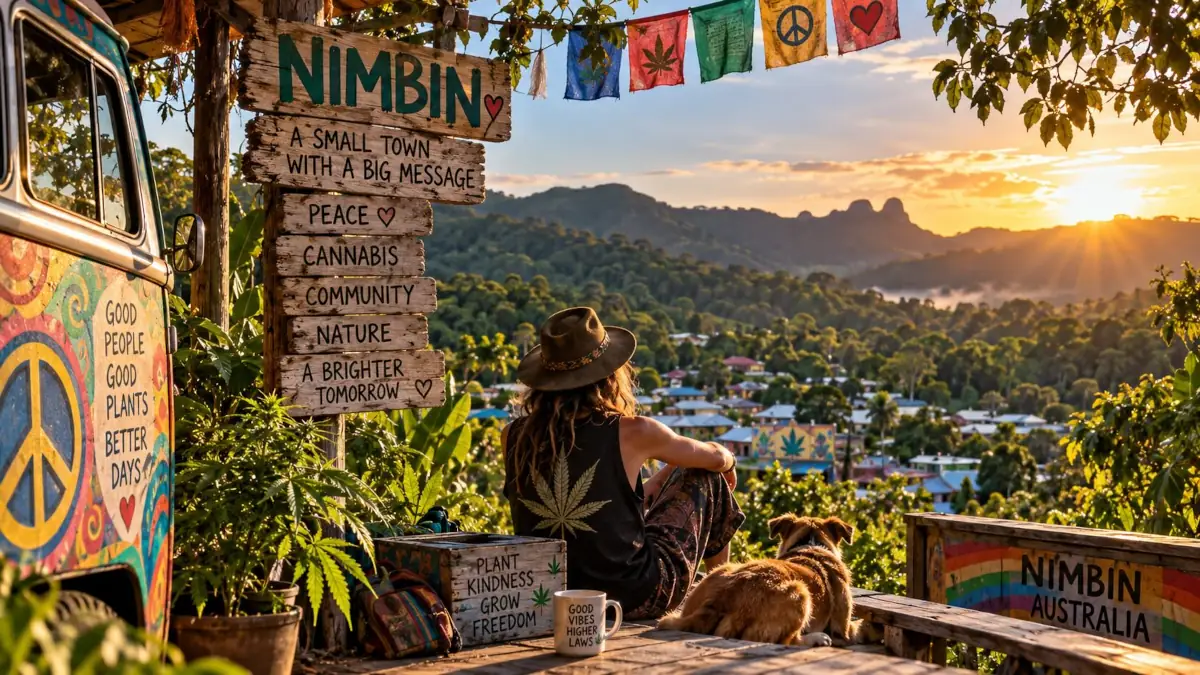
Hidden among the green hills of northern New South Wales, not far from Byron Bay, is a small Australian town whose reputation reaches surprisingly far beyond its modest population. Its name is Nimbin, and for more than half a century it has occupied a unique place in Australian counterculture.
Mention Nimbin to many Australians and one subject inevitably enters the conversation: cannabis.
Colorful shopfronts, alternative communities, environmental activism, psychedelic artwork and decades of campaigning for cannabis law reform have made Nimbin something of an Australian legend. Visitors arrive expecting a hippie town frozen in the 1970s and discover something considerably more interesting: a community where alternative culture, politics, tourism, environmentalism and cannabis activism have developed together over generations.
Nimbin’s association with marijuana is therefore about much more than getting high. To understand why this tiny town became Australia’s unofficial cannabis capital, you have to go back to the extraordinary events of 1973.
Before Cannabis Made Nimbin Famous
Nimbin was not always a countercultural destination.
Long before European settlement, the region formed part of the traditional lands of the Bundjalung people. European settlement subsequently transformed the landscape, and Nimbin developed primarily as an agricultural community associated with dairy farming, bananas and the surrounding rural economy.
By the second half of the twentieth century, however, changing agricultural conditions had left the little town struggling economically.
Then came 1973.
That year Nimbin was chosen as the location for the Aquarius Festival, a ten-day gathering organized by the Australian Union of Students. Thousands of young people, artists, musicians, environmentalists and alternative thinkers descended upon the town.
Aquarius was not simply another music festival.
Participants experimented with communal living, alternative architecture, vegetarian food, environmental ideas, spirituality, art and different concepts of social organization. The atmosphere reflected the enormous cultural changes taking place around the Western world during the late 1960s and early 1970s.
And when the festival finished, something unusual happened.
Many participants didn’t leave.
The 1973 Aquarius Festival Changed Nimbin Forever
Some festival-goers remained around Nimbin and northern New South Wales, where comparatively inexpensive rural land made it possible to establish communes and intentional communities.
Alternative settlements appeared throughout the surrounding countryside.
People experimented with organic agriculture, renewable energy, cooperative ownership and communal living. Environmental campaigns also became increasingly important to the identity of the region.
Cannabis naturally became part of this emerging counterculture.
The connection was hardly surprising. During the 1960s and 1970s, marijuana had become closely associated internationally with youth culture, opposition to conventional social values, music, artistic experimentation and political protest.
But in Nimbin that relationship endured long after the original hippie era had disappeared elsewhere.
Over the following decades, the town gradually developed one of Australia’s most visible cannabis cultures.
Nimbin and Cannabis: How a Reputation Became an Identity
Walk along Cullen Street, Nimbin’s main street, and the town’s alternative heritage remains immediately visible.
Bright murals cover buildings. Shops sell locally produced crafts, alternative clothing and hemp-related products. Musicians and travelers mix with residents, activists and tourists. The atmosphere is distinctly different from that of a conventional Australian country town.
Cannabis imagery is difficult to miss.
The famous leaf has become almost an unofficial visual symbol of Nimbin.
This doesn’t mean Nimbin exists outside Australian law. Cannabis possession, supply and unauthorized cultivation remain regulated by law in New South Wales, and visitors should never confuse the town’s tolerant reputation with blanket legalization.
That contradiction, however, is precisely what has shaped much of Nimbin’s modern history.
Rather than simply accepting prohibition, generations of local activists have openly campaigned to change cannabis laws.
The Nimbin HEMP Embassy
One of the institutions most closely associated with this movement is the Nimbin HEMP Embassy.
Established in 1992, the Embassy became a permanent center for cannabis education and law-reform activism in the middle of Nimbin.
HEMP stands for Help End Marijuana Prohibition, which makes its purpose fairly difficult to misunderstand.
The organization campaigns for changes to cannabis legislation and provides information about the plant, hemp and cannabis policy. Importantly, the Embassy itself states that it does not sell drugs.
Its significance is cultural as well as political.
While cannabis activism in many places appears periodically around elections or legislative debates, Nimbin has maintained a highly visible cannabis-law-reform movement for decades.
That continuity helped turn the town into an international symbol.
And once a year, the movement becomes considerably louder.
MardiGrass: Nimbin’s Great Cannabis Protest
If there is one event that embodies Nimbin’s relationship with cannabis, it is Nimbin MardiGrass.
The annual cannabis law reform rally began in 1993 and developed into one of Australia’s best-known cannabis events.
Despite the playful name, MardiGrass has always had a serious political objective: challenging cannabis prohibition and encouraging public discussion about marijuana laws.
Over the years, however, political protest has combined with something closer to a festival.
Nimbin fills with visitors. There are talks, debates, music, performances, markets, demonstrations and educational events covering recreational cannabis, medicinal cannabis, industrial hemp and drug policy.
The result has sometimes been described as a “protestival” — part protest, part festival.
The famous MardiGrass parade brings cannabis imagery into the streets, while the event’s sense of humor has produced traditions that would seem improbable almost anywhere else.
Hemp Olympix, Ganja Faeries and the Lighter Side of Protest
One reason MardiGrass has survived for so many years is that Nimbin learned how to mix political activism with spectacle.
Among the event’s best-known traditions are the Hemp Olympix, which have included unconventional competitions such as joint rolling and bong throwing.
Another distinctive sight is the procession of elaborately dressed Ganja Faeries.
Then there is the Kombi Konvoy, celebrating the Volkswagen vans forever associated with hippie travel and the alternative communities that developed around Nimbin after Aquarius.
Behind the humor lies a deliberate strategy.
Instead of presenting cannabis law reform exclusively through politicians, statistics and formal campaigning, MardiGrass transformed activism into a public cultural event.
People can debate policy in one part of town and encounter music, street theater or eccentric competitions somewhere else.
That combination has helped make Nimbin synonymous with cannabis far beyond Australia.
Cannabis Seeds and the Changing Cannabis World
The cannabis world itself has changed enormously since Nimbin first acquired its marijuana reputation in the 1970s.
At that time, cannabis genetics traveled largely through informal networks. Travelers and enthusiasts moved marijuana seeds between countries and regions, helping different varieties spread far beyond their geographical origins.
Today cannabis genetics have become an international field of their own.
Specialized seed banks preserve and develop thousands of varieties, and terms such as cannabis seeds, feminized seedsand autoflowering seeds have become part of the everyday vocabulary of modern cannabis culture.
Feminized seeds represented a major development because they are bred to produce female plants with very high reliability. Autoflowering seeds introduced another distinctive category, based on genetics that flower according primarily to plant maturity rather than the traditional dependence on changing daylight periods.
For a place such as Nimbin, this evolution is particularly interesting.
The town’s cannabis identity originated during an era when cannabis knowledge was passed primarily from person to person. Today information about cannabis varieties, cannabinoids, genetics and marijuana seeds moves instantly around the world.
The culture has gone global, while Nimbin remains one of the places associated with its earlier countercultural roots.
From Marijuana to Medicinal Cannabis
Public attitudes toward cannabis have also changed significantly since the Aquarius generation arrived in Nimbin.
For decades, marijuana debates were usually framed almost entirely around recreational drug use and prohibition.
Today the conversation is considerably broader.
Medicinal cannabis has become an established subject of scientific, medical and political discussion, and regulated access exists in Australia under specific circumstances.
Research into cannabinoids has simultaneously made terms such as THC and CBD familiar to people who may never have considered themselves part of cannabis culture.
Industrial hemp has undergone a similar reassessment.
Cannabis varieties cultivated for hemp can provide fiber, food ingredients, building materials and other products. Hemp’s reappearance in mainstream discussion has reinforced one of the arguments Nimbin activists have made for decades: cannabis is a remarkably versatile plant and cannot be understood exclusively through the stereotype of recreational marijuana.
Cannabis Genetics: Feminized and Autoflowering Seeds
Modern cannabis culture is also much more interested in genetics than it was during Nimbin’s early counterculture years.
Different cannabis varieties can express very different characteristics, cannabinoid profiles, aromas and growth patterns.
This has created a sophisticated international market for cannabis seeds.
Two categories in particular have become widely recognized: feminized seeds and autoflowering seeds.
Feminized cannabis seeds were developed to dramatically increase the probability of female plants. Autoflowering cannabis seeds, meanwhile, incorporate autoflowering traits historically associated with Cannabis ruderalis, allowing flowering to occur according primarily to age rather than relying exclusively on seasonal changes in daylight.
For collectors, breeders and people interested in preserving cannabis genetics, marijuana seeds have consequently become a way of maintaining genetic diversity.
Laws regarding cannabis seeds, germination and cultivation differ substantially between countries and jurisdictions, so anyone purchasing or possessing seeds should always understand the legislation applicable where they live.
Is Cannabis Legal in Nimbin?
This is probably one of the most important misconceptions about the town.
Nimbin is not an independent cannabis republic.
Its reputation for tolerance does not override the laws of New South Wales.
Cannabis laws have changed considerably around Australia over the years, particularly in relation to medicinal use and different approaches to possession, but visitors should not assume that recreational cannabis is legal simply because they see marijuana imagery everywhere in Nimbin.
In fact, the continued existence of MardiGrass makes more sense once this distinction is understood.
If cannabis were simply legal in Nimbin, there would be considerably less reason for an annual cannabis-law-reform rally.
The tension between local culture and the law is part of the town’s identity.
More Than Marijuana: The Other Side of Nimbin
Reducing Nimbin entirely to cannabis would nevertheless miss much of what makes the place unusual.
The surrounding region is spectacular.
Nimbin sits within the lush landscape of northern New South Wales, an area of subtropical vegetation, mountains, forests, creeks and waterfalls.
The environmental movement has deep roots here.
Many people who settled around Nimbin following the Aquarius Festival were attracted not merely by alternative social ideas but by experiments in sustainable living, organic agriculture and environmental protection.
Artists also became part of the community.
That legacy remains visible in the murals, galleries, crafts, music and handmade products found around town.
So while cannabis may be the keyword that puts Nimbin on the map for many international visitors, it is only one part of a much larger countercultural experiment.
Why Cannabis Tourists Still Visit Nimbin
Cannabis tourism has changed.
Travelers today can visit places where regulated recreational marijuana markets exist, something almost unimaginable when Nimbin’s cannabis reputation was developing.
Yet people continue to visit Nimbin.
Why?
Because Nimbin offers something different.
Its attraction isn’t based on polished dispensaries or a commercial cannabis industry. It comes from history.
Visitors are entering a town shaped by more than fifty years of alternative culture and decades of organized cannabis activism.
There is an authenticity to that story which cannot easily be manufactured.
The Aquarius Festival really happened here. People really stayed. Communities really formed. Cannabis activists really spent decades challenging prohibition. MardiGrass really grew from a local protest into an internationally recognized celebration of cannabis culture.
Nimbin did not become associated with marijuana because someone designed a tourism campaign.
Its reputation grew organically.
Nimbin, Australia and the Future of Cannabis
More than half a century has passed since thousands of young countercultural travelers arrived for the Aquarius Festival.
The world surrounding cannabis has changed almost beyond recognition during that time.
Medicinal cannabis is now discussed by doctors and governments. Cannabis research appears in scientific journals. Industrial hemp has returned to agriculture and manufacturing. Cannabis genetics are preserved and exchanged internationally through modern seed banks offering regular, CBD-rich, feminized and autoflowering seeds.
And debates about legalization continue around the world.
Through all of those changes, Nimbin has retained its peculiar place in cannabis history.
The town represents an earlier chapter of the movement — one rooted in communes, environmentalism, political activism, hippie culture and the belief that society could organize itself differently.
That history is precisely why Nimbin remains relevant.
Nimbin: Still Australia’s Cannabis Capital?
Calling Nimbin a “cannabis paradise” has always contained a little exaggeration.
Cannabis isn’t simply legal there, and everyday life in the town involves considerably more than marijuana.
But if the title means somewhere where cannabis culture has profoundly influenced a community’s identity, politics, art, tourism and international reputation, then Nimbin has few competitors in Australia.
From the Aquarius Festival of 1973 to the creation of the HEMP Embassy, from the first MardiGrass in 1993 to today’s worldwide discussions about medicinal cannabis, cannabis seeds and changing marijuana laws, Nimbin has occupied a remarkable position in Australian counterculture.
Perhaps that is the real reason travelers continue making the journey into the hills of northern New South Wales.
They aren’t simply visiting somewhere associated with cannabis.
They’re visiting a small Australian town where an experiment in alternative living that began more than fifty years ago never entirely ended.
And whatever happens to cannabis laws in the decades ahead, that makes Nimbin a fascinating little piece of marijuana history.